Monday, 4 June 2012

Lab Report- Create Our Own One


Lab Report
Despina Katsirouba
7A Science
Mrs. Medenica
June 4th 2012

Guiding Question: Which of the rubber bands with different thicknesses and diameters of the caps make the strongest, loudest sound?

Hypothesis: The thickest rubber band that is stretched the most will also make the loudest sound.

Variables:  
  • Controlled: strength of the pull, sizes of the rubber bands
  • Manipulated: stretching of the rubber bands
  • Responding: different sounds the rubber bands create

Materials: rubber bands (of three different thicknesses), caps of jars with different diameters, ruler, iphone to measure the VU

Procedure:
First you have to measure the diameters of the caps and the thicknesses of the rubber bands. Then you put the rubber bands around the caps and pull them to create a sound. Then see which rubber band on which jar makes the loudest sound.

Diameters of caps:
  1. 12 cm
  2. 10 cm
  3. 9.5 cm

Thicknesses of the rubber bands:
  1. 0.5 cm
  2. 0.3 cm
  3. 0.2 cm

Recordings (in volume units):

Rubber Band 1:
  • Cap 1: 10 VU
  • Cap 2: 7 VU
  • Cap 3: 15 VU
Rubber Band 2:
  • Cap 1: 15 VU
  • Cap 2: 7 VU
  • Cap 3: 15 VU
Rubber Band 3:
  • Cap 1: 7 VU
  • Cap 2: 10 VU
  • Cap 3: 18 VU

Data Table/s (This is as far as you will get until you complete the table, but you MUST know what data you will collect BEFORE you begin)  

Graphs:


Data Analysis: The thinnest rubber band on the smallest cap makes the loudest sound, 18 VU. A pattern that I recognized on rubber bands one and two on the second cap is that they both make 6.5 VU. The same rubber bands make the same VU, 14.5, on cap three. I don’t think our data was very precise since the i-phone source was not very good so the numbers that are sown in the graph may not be the exact ones but very close.

Conclusion: Which of the rubber bands with different thicknesses and diameters of the caps make the strongest, loudest sound? The thinnest rubber band placed around the smallest one. Our answer to your guiding question was not even close to out hypothesis since we said the opposite; that the thickest rubber band will make the loudest noise around the bigger cap. The i-phone application that we used was not very precise but if we had used a special tool that probably Dr. G has. Since we had to create our own lab I think the application was enough. In my opinion, our hypothesis was based on our basic knowledge of sound waves, since it is thick so it would probably make the thickest sound just like the guitar.

Further Inquiry: The application that we used on the i-phone to measure the VU was not very accurate so the number had to be rounded so not very precise. Although we went to a quiet room where there was no one there so no sound occured but again it was not as precise as we expected it to be. We could have used a tool that probably Dr. G has to measure it more precisely. Next time we would try to find another way of measuring. Also we could use caps with more difference between them so the results would be higher in difference and try it many times so it can be more precise. The reasons our results came out really close to each other is because there wasn’t much difference between the caps, the application was not very precise and the thickness of the rubber bands wasn’t much. I don’t think we would change the hypothesis or inquiries if we had a different tool.

Saturday, 2 June 2012

One World Blogpost- Hurricanes

            Every year there are few, but devastating hurricanes, tornadoes and other strong winds forming usually near the Unites States of America (USA). In every day we don’t talk about them very much and it is not usual one to occur so this is why I chose this topic. For those who don’t know what a hurricane is and want to be informed, a hurricane is a rotating oceanic wind that usually forms over tropical oceanic regions. This is because they way they occur.
            Their birth is a complicated and detailed thing to explain. First, think that it is an engine used to warm and its source is moist air. Since it needs moist air, it forms over warm oceans, near the equator, and causes the air to rise. As there is less air near the surface of the sea, less pressure, air with high pressure from other areas comes near the ocean surface forming a ‘new’ air which also rises. As it rises, it swirls and as it slowly cools down it forms clouds. Then it spins and continues while moving by the provided ‘fuel’. When it is formed north of the equator it goes counterclockwise and in the south it moves clockwise because of the rotation of the Earth on its axis.
            As I just mentioned, a hurricane needs moist air as fuel so it forms in the biggest ocean, the Pacific. It only once formed in the Atlantic Ocean on August 23, 2005 and caused huge disaster to the citizens of Bahamas and Florida. When there is a hurricane to occur and we kind of prevent it, is by the season. When it is April-December it forms northern, near India, but when it is October-May it occurs in the southern regions.
            A hurricane is very strong and always damages and effects cities/regions/areas. The effects of it are sort surges- strong winds that push the water near the coast, heavy rainfalls-6-12 inches) high winds, rip tides and sea currents. Its disadvantages are many and cause both physical and emotional pain. First, it transports warm air in cooler places that can be both bad and good-the poles may melt even a little bit, people and aniamls die, buildings, houses, agriculture areas are ruined, trees and other vegetation is ruined and it spreads out lots of debris. Although I would never believe it a hurricane has its benefits. It reduces population- we are overpopulated, although it causes suffer and pain- it helps agriculture by bringing the fertile soil on top, architecture get improved my building more stable houses and it brings people together.
            It’s not very easy to predict hurricanes although high pressure system can tell whether there is low pressure and there is not a way to prevent them yet. Scientists can use information they already have from tornadoes or hurricanes passed because they keep track of them on the computer and can tell in how many days or hours the next one will occur approximately.  Since 1492 there is a scale called the decadal scale that shows us the different amount of hurricanes occurred every 10-30 years so we can study the record to see if ‘it’s time’ for a hurricane to occur.   From this study, we have learned that there are 6 hurricanes, small or big, every season that occur. It’s really interesting. A really good thing that could help us stop or reduce the size of a hurricane is cool the water down since it will not take us much fuel and grow as much. A very interesting fact is that it is stronger on its right side so you should have your eyes open if you live on the right front quadrant. Because of all the disaster it causes, several government sponsor projects for the design of the study of storms and finding ways to control them. In my opinion, people should built their houses from brick, so it is more stable and find a way to cool don’t the ocean or at least the seas near the land so it doesn’t ‘eat’ that much so it stops before millions of lives are lost.
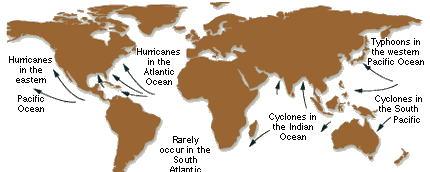
            You might have noticed that I have mention cyclones and other words that have nothing to do with hurricanes but in fact, they mean the same thing. It all depends in where they occur. Their scientific term is tropical cyclones but in the Atlantic Ocean they are called hurricanes, although we use it for the Pacific too. Another word is typhoon. My biggest question from this whole topic is how they are named. What I found out answered fully my question and what I found out is really interesting and it was unexpected. Before the 50’s, they had no name and till 1952, they had simple names like Dog, Cat or George. In 1953, someone deiced to give only women names, since lots of people say they are a disaster, but in 1979 this changed. It had names between the two genres. Now days, they are named alphabetically every year and the second letter depends on the order. For example the name Wilma came from a season that was very but very busy since I is one of the last letters in the alphabet.
                My opinion about the topic is pretty clear. Since almost the only place that has hurricanes is America, they should build their houses from brick, like in Europe and it doesn’t matter that it costs more. It saves lives and money for the next hurricane. The best action in my opinion they should take is when they hear about the hurricane leave town and come back when it is over. And don’t forget the basic thing! ARCHITECTURE!!! BRICK!!


Bibliography:
  •  "The Benefits/Advantages and Disadvantages of Some Natural Disasters (Floods,
     Volcanoes, and Hurricanes)." Loi-Renee. N.p., n.d. Web. 2 June 2012.
     <http://loi-renee.hubpages.com/hub/
     The-Benefits-and-Disadvantages-of-Some-Natural-Disasters-Floods-Volcanoes-and-Hur
     ricanes>.
  • "Effects of a Hurricane." Teachertech. N.p., n.d. Web. 2 June 2012.
         <http://teachertech.rice.edu/Participants/louviere/hurricanes/
         effects.html>.  
  • "How Do Hurricanes Form?" Space Place. N.p., n.d. Web. 2 June 2012.
         <http://spaceplace.nasa.gov/hurricanes/>. 
  • "Hurricane Features." Comet. N.p., n.d. Web. 2 June 2012.
         <http://www.comet.ucar.edu/nsflab/web/hurricane/311.htm>. 

  • "Hurricane Information." Mars Bunny. N.p., n.d. Web. 2 June 2012.   <http://www.marshbunny.com/hurricane/storms.html#3>.      
  • "Hurricanes Facts & Features." AccuWeather. N.p., n.d. Web. 2 June 2012.
         <http://www.accuweather.com/en/weather-blogs/hurricanefacts/
         when-and-where-do-hurricanes-o/31028>. 
  • "Hurricanes/Tropical Cyclones." NASA. N.p., n.d. Web. 2 June 2012.
         <http://www.nasa.gov/mission_pages/hurricanes/multimedia/
         AtlanticHurricanesWithJeffPage7.html>. 
  • Meinelli. Interview. How do Scientists Predict Hurricanes Today. NASA. N.p.,
         n.d. Web. 2 June 2012. <http://www.nasa.gov/mov/
         264644main_119_Hurricanes_Today.mov>. 
  • "Science: The Benefits of Hurricanes." Time. N.p., n.d. Web. 2 June 2012.
         <http://www.time.com/time/magazine/article/0,9171,907967,00.html>.

Friday, 25 May 2012

Epicenter Analysis

Analayze and Conclude

  1. Observe the 3 circles you have drawn. Where is the earthquake's epicenter? The epicenter of the earthquake is somewhere near Kentucky (Frankfort)
  2. Which city on the map is closest to the earthquake's epicenter? How far, in kilometers, is the city from the epicenter? The closest city, in the map, to the epicenter of the earthquake is Nashville  and it is 100 kilometers far
  3. In which of the 3 cities listed in the data table would seismographs detect the earthquake first? Last? The first one is Chicago the next one is Houston and the last one is Denver
  4. About how far from San Francisco is the epicenter that you found? What would the difference be in arrival times of the P waves and S waves for a recording station in San Francisco. The difference in arrival times is 2,800 kilometers
  5. What happens to the difference in arrival times between P waves and S waves as the distance from the erthquake increases?